1 中国ヒアリング回答(1)
Question 1 Basic principle concerning representations of designs
Question 1-1 In the laws, regulations, examination guidelines, etc., of your country, there are provisions concerning the disclosure of designs. What is the underlying principle behind those provisions that determines the extent of disclosure of designs? In other words, when determining the extent of disclosure of designs, what are the primary goals of your country?
Example answers are listed below. Please give us a detailed answer.
- To facilitate formality examination or substantive examination.
- To facilitate storage of the submitted representations (drawings, photographs, specimens, etc.).
- To reduce the burdens on the users of the design system.
- To facilitate understanding of third parties (those other than design applicants and design holders)
- To facilitate the enforcement of rights.
- To ask for self-responsibility of the applicant who discloses his/her design.
Answer Section 1-1 (Provided by examiner in Design Department of SIPO)
To facilitate understanding of third parties (those other than design applicants and design holders)
第三者(意匠出願人/権利者以外の者)の理解を容易にするため
Question 1-2 In many cases, designers design industrial products by using 3D CAD and CG software. Does your country allow design applicants to use the 3D CG images created in the stage of product design such as those shown below as design representations to be included in design application documents?
[Article which constitutes the Design] Attachable wash-basin [International Design Classification] 23-02
[Description of the Article which constitutes the Design] This design will be used mostly by medical staff to wash their hands in medical facilities, etc.
2 Japan Design Registration No. 1442550
Answer Section 1-2 (Provided by examiner in Design Department of SIPO)
Design applicants can use the 3D CG images.
意匠出願人は、3DのCG画像を使用できる。
[Perspective view]
[Top view] [Front view]
[Right side view]
[A-A sectional view] [The article in use]
[Left side view] [Bottom view]
3
Question 2 Representations of designs under the system to protect the design of a part of an article (partial design system)
Question 2-1 This is a question to the IP Office of any country that has either a partial design system or a system to protect the design of a part of an article. If you are representing the IP Office of any country that has neither of these systems, please skip this question and answer Question 2-2.
Two specific examples of representations of partial designs are given below. In the case of Example 1, an applicant seeking protection for a partial design used a different color to distinguish the partial design from the rest of the article. In the case of Example 2, an applicant seeking protection for a partial design used a different line (broken line) to distinguish the partial design from the rest of the article. Does your country allow such representations of partial designs? Please tell us whether and why each of the following two methods shown in the following examples is permitted or not?
(Example 1) A case where an applicant seeking protection for a partial design used a different color to distinguish the partial design from the rest of the article
Japan Design Registration No. 1444223
(Example 2) A case where an applicant seeking protection for a partial design used a different line to distinguish the partial design from the rest of the article
[Article which constitutes the Design] Passenger car [International Design Classification] 12-08
[Description of the Design] The applicant is seeking registration of the partial design of the part other than the pink part shown in the drawings. The bottom view is omitted because this is a heavy article. The shading applied to the entire surface of the 3D configuration presented in each drawing shows the shape of the curved surface.
[Article which constitutes the Design] Packaging container
[International Design Classification] 09-01、09-02、09-03、09-04、09-05、28-01
[Description of the Design] The part drawn by a solid line shows the part for which the applicant is seeking registration as a partial design.
The rear view is symmetrical to the front view The bottom view is the same as the top view.
The enlarged rear view of the cap is symmetrical to the enlarged front view. The enlarged bottom view of the cap is symmetrical to the enlarged top view.
[Perspective view] [Front view] [Rear view]
4
[Front view] [Top view]
[Left side view] [Right side view]
[Enlarged perspective view of the cap 1]
[Enlarged perspective view of the cap 2]
[Enlarged front view of the cap] [Enlarged top view of the cap]
[Enlarged left side view of the cap]
[Enlarged right side view of the cap]
5 Japan Design Registration No. 1449069
Question 2-2 This is a question to the IP Office of any country that has neither a partial design system nor a system to protect the design of a part of an article. If you are representing the IP Office of any country that has either of these systems, please skip this question and answer Question 3.
Do the users of the design system of your country request protection for the partial designs of articles? For example, is there a need for the establishment of a partial design system, which is an effective countermeasure against infringers of partial designs who copy only a unique and innovative part of an article without copying the design of the article as a whole?
Answer Section 2-2 (Provided by examiner in Design Department of SIPO)
Yes,We do have a need for the establishment of a partial design system. 部分意匠制度のニーズはある。
Question 3 The policy of conducting to find designs
Please answer this question regardless of whether your country has adopted a system that conducts only formality examination before registration, a system that conducts both formality examination and substantive examination before registration, or a system that conducts formality examination on all applications and conducts substantive examination only on certain applications before registration.
Question 3-1 In the course of formality examination on the design claimed in an application, to what extent do you conduct to find the design? Example answers are listed below. Please give us a detailed answer.
- We examine whether an application satisfies the prescribed formality requirements such as the number, sizes, etc., of the submitted drawings or photographs but do not examine the design in further detail.
- In addition to whether a design satisfies the formality requirements, we conduct to find out whether the design is disclosed in accordance with the relevant regulations by taking into consideration the article that embodies the design and checking the drawings, photographs, etc., submitted by the applicant.
6
requirements for design registration (e.g., the case where the design clearly lacks novelty), we conduct substantive examination as well
Answer Section 3-1 (Provided by examiner in Design Department of SIPO)
In addition to whether a design satisfies the formality requirements, we conduct to find out whether the design is disclosed in accordance with the relevant regulations by taking into consideration the article that embodies the design and checking the drawings, photographs, etc., submitted by the applicant.
形式的な要件に加え、意匠にかかる物品を考慮し、提出された図面あるいは写真等を精査 して意匠を認定し、規定通りに意匠が開示されているかを判断する。
Question 3-2 Who conducts the formality examination mentioned in Question 3-1? Is it conducted by a formality examiner, Office staff member, or any other staff member (including a substantive examiner)? Please specify.
Question 3-3 Do you have a system to invalidate a registered design right on the grounds that the design is unclear for such reasons as the design right having an unidentifiable scope? Example answers are listed below. Please give us a detailed answer.
- System to file a request with the IP Office for commencement of examination - System to file a request with the IP Office for an invalidation trial
- System to file a lawsuit with a court
Answer Section 3-3 (Provided by examiner in Design Department of SIPO)
We gave a system to file a request with the IP Office for an invalidation trial.
知的財産担当官庁に対する無効審判の請求制度がある。
Question 3-4 Is there any judicial precedent where the clarity of a design representation was at issue? If yes, please summarize the judgment and tell us the grounds on which the court found the design representation to be unclear.
Answer Section 3-2 (Provided by examiner in Design Department of SIPO)
Only the formality examiner.
7
Answer Section 3-4 (Provided by examiner in Design Department of SIPO)
Yes, there are.
If the content of the drawings or photographs of a design patent has defects that cause the uncertainty of the protection target of design, it may be excluded from the patent protection under Article27.2 of the Patent Law of China.
ある。意匠特許の図面または写真の内容に瑕疵があり、それによって意匠の保護対象が不
明確な場合は、専利法第27.2条に基づき、特許保護が受けられない可能性がある。
Question 4 Principle concerning amendments
Question 4-1 Is it permitted to amend a design application? If yes, what restrictions are imposed on an amendment in terms of time schedule and content? Please tell us any restrictions imposed on an amendment in practice other than those specified in the laws, regulations, examination guidelines, etc., that we should know about. Furthermore, is it permitted to make a voluntary amendment?
Answer Section 4-1 (Provided by Linda LIU & Partners)
Yes, it is permitted to amend a design application. Amendments can be made according to the examiner’s request or initiatively by the applicant.
可能。意匠出願の補正は認められる。補正は審査官の要求により、または出願人が自発的 に行うことができる。
After receiving the official notification from SIPO, the applicant can make amendments to the defects that indicated by the examiner within the designated time limit, usually within 2 months from receiving the notification.(Rule 44 of the Implementing Regulations of the Patent
Law of China)
SIPOから通知を受けた場合、出願人は、指定された期限(通常は2カ月)内に、審査官が
指摘した瑕疵を補正することができる(専利法実施細則第44条)。
Voluntary amendments to the drawings/ photographs or explanation of the design can be made within two months from the filing date. (Rule51.1 of the Implementing Regulations of the Patent Law of China)
図面/写真または意匠の説明に対する自発的な補正は、出願日から 2カ月以内に行うこと
8
All the amendments may not go beyond the scope of the disclosure as shown in the initial drawings or photographs. (Article 33 of the Patent Law of China)
すべての補正は、最初の図面や写真による開示の範囲を超えてはならない(専利法第 33
条)。
Question 4-2 What may be submitted to make an amendment? Please tell us what may be submitted in practice other than those specified in the laws, regulations, examination guidelines, etc.
Answer Section 4-2 (Provided by examiner in Design Department of SIPO)
To make an amendment, the applicant shall submit rectification with the signature or seal on it, and the corresponding replacement sheet of the amended documents.
補正を行うには、出願人は、署名または捺印した修正(rectification)、および補正する書類
の差替えを提出しなければならない。
Question 4-3 If the IP Office refuses to accept any amendment made in response to an amendment order or made voluntarily, what action would the IP Office take? Is there a possibility that the IP Office dismisses the design application? Or, if only a minor defect is involved, would the IP Office accept amendment and register the application which was amended?
Answer Section 4-3 (Provided by examiner in Design Department of SIPO and Linda LIU & Partners)
With regard to the amended documents which can not be accepted, the examiner shall issue the Office Action to notify the applicant that the amendment is not conformity with the provision of Article 33. If the amendment is still not in conformity with the provisions after the application makes observations or rectification, the examiner may make a decision of rejection according to the provisions of Article 33 of the Patent Law of China and Rules44.2 of the Implementing Regulations of the Patent Law of China.
認められない補正については、審査官がオフィスアクションによって、補正が第 33条の規定
に適合していないことを出願人へ通知する。出願人による意見または修正の提出後、補正が依
然として規定に適合していない場合、審査官は、専利法第33条および専利法実施細則第44.2
9
Question 4-4 Even though a design application is satisfied the formality requirements, are there any cases where the IP Office sends the applicant a instruction for an amendment related to a representation of the design in order to facilitate to conduct finding the design or to make the representation of the design more accurate? Please tell us what is stated in such a request in detail.
Answer Section 4-4 (Provided by examiner in Design Department of SIPO and Linda LIU & Partners)
Yes, there are many cases where the IP Office sends the applicant an instruction for an amendment related to a representation of the design, here, we just take the following two cases as the examples.
So far as the product with a three-dimensional design is concerned, if the essential features of the design of the product involve six side, the applicant shall submit orthographic projection of six side view; if the essential features of the design of the product involve the view of one side or several sides only, the applicant shall submit at least orthographic projection view and space diagram of the side concerned, and indicate the reason of the omission of the view in the brief explanation, if the above-mentioned views are not sufficient, the IP Office will send an instruction for an amendment. In addition, the relation of projection is wrong, for example, the relation of projection is not conformity with the rules of exact projection, corresponding projection relation among the views lacks, or the direction of the view is upside-down, so that the drawings or photographs may have more than one possibility to explain the design product, the IP Office can send the applicant an instruction for an amendment.
ある。知的財産担当官庁が意匠の表現に関しての補正を促す通知をする場合は多いが、ここで
は、例として以下の2つのケースを挙げるにとどめる。立体意匠に関し、意匠の本質的な特徴
に6面が含まれる場合は、6面の正投影図を提出しなければならない。意匠の本質的な特徴が、
1 面またはいくつかの面のみの場合、少なくとも、その面の正投影図および空間図を提出し、
Yes, there is a possibility that the IP Office dismisses the design application. 意匠出願が却下される場合はある。
With regard to the amendment made two months later, if the amended documents overcome the defects existing in the initial application documents, and have the prospect of being granted the patent, the amended documents may be accepted.
2カ月後に行われた補正については、最初の出願書類に存在する瑕疵が、補正書類において解
決されており、特許付与される見込みがある場合は、補正された書類を受理されると考えられ
10
図を省略した理由を簡潔に示さなければならない。上述の図が不十分な場合、知的財産担当官
庁は補正を促す通知を行う。また、投影の関係が間違っている場合、例えば、投影の関係が正
確な投影の規則に従っていない場合、図どうしの対応する投影の関係がない場合、図が逆さま
の場合など、図面や写真による意匠の説明に複数の可能性があるときも、知的財産担当官庁は
補正を促す通知を行うことができる。
Question 4-5 In the case mentioned in Question 4-4, if the IP Office sends an instruction to an applicant, is the applicant required to make an amendment strictly in accordance with the instruction? Or, is the applicant permitted to make an amendment in the way he/she wishes to a certain extent? Please explain in detail.
Answer Section 4-5(Provided by examiner in Design Department of SIPO)
The applicant is permitted to make an amendment in the way he/she wishes to, but the amendment may not go beyond the scope of the disclosure as shown in the initial drawings or photographs.
出願人は、本人が希望する形で補正を行うことが認められるが、補正は、最初の図面/写 真における開示の範囲を超えてはならない。
Question 4-6 Is it permitted for a design applicant to divide the application and file a divisional application as a new design application? If we yes, what restrictions are imposed on the filing of a divisional application in terms of time schedule and content? Please tell us any restrictions imposed in practice other than those specified in the laws, regulations, examination guidelines, etc., that we should know about. For instance, is it permitted to divide a design application for a whole article and file a divisional design application for a new part or component?
Answer Section 4-6 (Provided by examiner in Design Department of SIPO and Linda LIU & Partners)
11
partitioned or sold and used independently), and these views can clearly represent this part, it is permitted to file a divisional application.
規則42に基づき、意匠出願を分割して新たな意匠出願とすることは認められる。分割出願
は、特許庁が原出願に対して交付した特許権付与通知を受け取った日から 2 カ月以内に提
出しなければならない。例えば、原出願が製品全体の意匠の保護を意図していて、製品全 体の図のみを提出している場合は、その製品の一部のみを、分割出願の対象として取り出 すことはできない。しかし、原出願書類に、製品の一部に関する図が含まれており(分割
できない、あるいは単独で販売/使用できない構成部分を除く)、明らかにその部分を表す
図である場合、分割出願を提出することが認められる。
Question 4-7 Before the according of the application filing date, is it necessary for the applicant to satisfy the requirements for representation of a design and a design should be found? Or, may the application filing date be accorded without finding a design as long as the formality requirements are satisfied (e.g., the number and size of drawings or photographs)?
Answer Section 4-7 (Provided by Linda LIU & Partners)
It is necessary for the applicant to satisfy the requirements for representation of a design and a design should be found.
意匠の表現の要件が満たされて、意匠の認定ができなければならない。
According the provisions of the Articles 27 and 28, where an application for a patent for design is filed, a request, drawings or photographs of the design and a brief explanation, the date on which the patent administration department under the State Council received the application shall be the date of filling. That is to say, once the applicant submits these documents, the filing date is determined.
第27条、第28条の規定によれば、意匠特許の出願は、特許出願書、当該意匠の図面または写
真、および当該意匠の簡単な説明を提出し、国務院が出願を受領した日を出願日とする。つま
り、出願人がこれらの書類を提出した時点で、出願日は決められる。
But in order to avoid extra procedures and fees caused by amendments after filing, or going beyond the scope of the disclosure as shown in the initial drawings or photographs, the drawings or photographs of the design should satisfy the requirements for representation of a design and a design should be found.
しかし、出願後の補正による追加的な手順や手数料の発生、あるいは最初の図面や写真による
開示の範囲を超えることを防止するため、意匠の図面または写真は、意匠の表現の要件を満た
12
Question 4-8 In the case specified in Question 4-7, after an applicant makes an amendment in response to an order for amendment that the IP Office issued on the grounds that the requirements for according the application filing date were not satisfied, if said requirements are satisfied as a result of the amendment, which date does the IP Office accord as the application filing date, either the first application filing date or the date on which the amendment was submitted?
Answer Section 4-8 (Provided by Linda LIU & Partners)
After an applicant makes an amendment in response to an order for amendment that the IP Office issued on the grounds that the requirements for according the application filing date were not satisfied, even if said requirements are satisfied as a result of the amendment, the first application filing date is still the application filling date.
出願日認定の要件を満たしていないとして知的財産担当官庁から補正指令が出されて、出 願人が補正応答した結果、出願日の認定の要件を満たした場合でも、最初に出願した日が 出願日になる。
Question 4-9 In the case of an IP Office that conducts to find a design as a prerequisite for according the application filing date, please answer this question. In the case of any other IP Office, please skip this question and answer Question 5.
In the case mentioned in Question 4-8, if an amendment submitted to the IP Office changes the gist of the design, how would the amendment be treated? Would it be dismissed? Or, would it be deemed as a new application filed on the date on which the written answer to the order for amendment is submitted? Please explain in detail.
13 Question 5 Principle of unity
Question 5-1 Please tell us the requirements for representations of designs in order for multiple designs to be regarded as a single design.
Please give us a detailed answer. For example, is it the case that the designs of articles that are used in a physically separated manner may be regarded as a single design as long as those designs are regarded as a set in terms of design (e.g., a set of stackable pans), that a set of similar designs may be regarded as a single design as long as those designs are similar to each other in terms of configuration1, that the designs represented in a drawing in a physically separated manner may be regarded as a single design as long as those articles are used simultaneously (e.g., a pen and its cap), or that the designs of different articles may be regarded as a single design as long as they are used simultaneously (e.g., a stationary article and its base)? Which requirements, either formality requirements (formality examination) or substantive requirements (substantive examination), must be met in order to recognize multiple designs as a single design? If multiple designs are not regarded as a single design, how would the IP Office treat them?
(Example) In Japan, a design application would be dismissed (i) if the applicant states two or more classifications of articles in the section entitled "Article which constitutes the design" of an application, (ii) if the applicant presents drawings of two or more articles, or (3) in the case of an application for the design of a part of an article, if the application covers two or more physically separated parts. If an application is dismissed for any of the aforementioned reasons, the applicant may file a divisional application (substantive requirements).
Answer Section 5-1 (Provided by Linda LIU & Partners)
In China, two or more similar designs for the same product or two or more designs which are incorporated in products belonging to the same class and sold or used in sets may be filed as one application According to Article 31of the Patent Law of China,.
専利法第31条によれば、中国では、同一製品における2以上の類似意匠、あるいは同一種類で
かつセットで販売または使用される製品の2以上の意匠は、1 件の出願として提出することが
できる。
“products belonging to the same class and sold or used in sets” means “are customarily sold or used at the same time and the design of which have the same concept”.
「同一種類でかつセットで販売または使用される」とは、一般的に同時に販売または使用され、
その意匠の概念が同じであることを意味する。
If the submitted designs satisfy the above requirements (Substantive requirements), it is permitted to be filed as one application. if not satisfy the above requirements, the examiner may ask the applicant to file a divisional application or delete the other designs.
提出された意匠が上記の要件(実体要件)を満たせば、1 件の出願として提出することが認め
られ、要件を満たさない場合、審査官が出願人に対して分割出願を提出するか、他の意匠を削
除するよう求めることができる。
14
Question 5-2 This is a question to the IP Office of any country that protects images. If your country does not protect images, please skip this question and answer Question 6.
Please tell us the provisions concerning representations of drawings that are required to be made in order to have multiple images regarded as a single design. Which requirements, either formality requirements (formality examination) or substantive requirements (substantive examination), must be met in order to have multiple images regarded as a single design? If multiple images are not regarded as a single design, how would the IP Office treat them?
(Example) In Japan, multiple images may be regarded as a single design covering multiple images in the case where the image before a change and the image after the change are used in relation to the same function of an article as long as those two images are considered to be related to each other in terms of configuration. If multiple images are not regarded as a single design, the application would be dismissed on the grounds that multiple images should be regarded as multiple designs (substantive requirements).
Answer Section 5-2
Question 6 Scope of design protection
15 Answer Section 6-1 (Provided by Linda LIU & Partners)
There is no specific definition
or ideasconcerning the similarity of the configurations of
designs. The determination should be made according to the knowledge and cognitive
capability of a normal consumer, and the comparison of designs shall be made through
the approach of whole observation and comprehensive judgment rather than through
observing parts or details of the designs.
意匠の形態類似に関する定義・概念はない。類似の判断は、一般的な消費者の知識および認識
能力に基づいて行うべきであり、意匠の比較においては、部分や詳細ではなく、意匠全体を観
察して、総合的な判断を行うべきである。
When making the determination, you should first determine whether the categories of
the products are identical or similar. If they are identical or similar, you may then
make a comparison between the two designs incorporated in the products. If they are
not identical or similar, there is no need to make a comparison. If the categories of the
products are identical or similar but the two designs incorporated in the products are
different, you need to further analyze whether the difference(s) makes(make) a notable
impact on the overall visual effect of the designs. If there is a notable impact, the two
designs do not constitute similar designs. If no notable impact is made (e.g. the
difference only lies in slight variations in some parts), the two designs will constitute
similar designs.
判断の際はまず、製品の分類が同一または類似しているかどうかを判断すべきである。同一ま
たは類似している場合は、それらの製品の2つの意匠の比較を行う。同一でないか類似していな
い場合は、比較を行う必要はない。製品の分類が同一または類似していても、それらの製品の2
つの意匠が異なる場合は、その相違が、意匠の全体的な視覚的影響に顕著な影響を及ぼすかど
うか、さらなる分析をする必要がある。顕著な影響があれば、2つの意匠は類似した意匠ではな
い。顕著な影響がなければ(例:相違が、一部におけるわずかな変化のみの場合)、2つの意匠
は類似した意匠である。
Interpretation of the Supreme People's Court on Several Issues concerning the
Application of Law in the Trial of Patent Infringement Dispute Cases has the following
provisions.
「特許侵害紛争裁判における法律適用に関するいくつかの問題に対する最高人民法院の解釈」
には以下のような規定がある。
16
第8条:特許付与された意匠と同一または類似の意匠が、分類が同一または類似の製品に使用
されている場合、人民法院は、被疑侵害意匠が、専利法第59.2条に定める「意匠特許による保
護の範囲」に入ると見なすものとする。
Article 11: Whether designs are the same or similar by comprehensively considering
design features of the patented design and the allegedly infringing design as well as the
overall visual effect of the designs. However, the design features mainly determined by
the technical effect of the product and those features that cannot affect the overall
visual effect, such as the material and internal structures, shall not be taken into
consideration.
第11条:意匠が同一または類似のものかどうかは、特許付与された意匠および被疑侵害意匠の
特徴、さらには両者の全体的な視覚効果を総合的に判断する。ただし、主として製品の技術的
効果によって決まる意匠の特徴や、全体的な視覚効果に影響を与えない特徴、例えば、材質や
内部の構造などは、考慮に入れないものとする。
The following exerts greater influence to the overall visual effect:
1. The parts of products which are easy to be observed directly in normal use;
2. The design features which distinguish the patented design from the existing designs.
次のものは、全体的な視覚効果に大きな影響を与える。1. 製品の通常の使用において、容易に直接観察できる部分
2. 特許付与された意匠を既存の意匠と区別する特徴
Where there is no difference in the overall visual effect between the allegedly
infringing design and the patented design, the People’s Court should recognize them as
the same. If there is no substantial difference in the overall visual effect between the
allegedly infringing design and the patented design, the People’s Court should
recognize them as similar.
被疑侵害意匠と特許付与された意匠との間で、全体的な視覚効果に差がない場合、人民法院は、
両者が同一であると認めるべきである。また、被疑侵害意匠と特許付与された意匠との間で、
全体的な視覚効果に大きな差がない場合、人民法院は、両者が類似していると認めるべきであ
17
Question 6-2 Please explain in detail how the scope of design protection is affected by the identity or similarity of articles or by the identity or similarity of the functions and use of articles. Please give us any judicial precedent where the court presented its interpretation as to how the scope of design protection is affected by these factors.
Answer Section 6-2 (Provided by Linda LIU & Partners)
No matter you are at the right-confirmation stage or the right-exercising stage, you
should first determine whether the categories of articles are identical or similar, and
then you may make a comparison between the designs of the articles.
権利確認の段階か、あるいは権利行使の段階かに関係なく、まず物品の分類の同一/類似を判
断することで、それらの物品の意匠を比較することができる。
Products of similar categories refer to products that have similar use. For example, a
toy and a tiny ornament are products of similar categories, because they have similar
use. It should be noted that for products having multiple uses, if some of the uses are
the same and some are not, they are regarded as products of similar categories.
分類が類似している製品とは、用途が類似した製品のことである。例えば、おもちゃと小型の
装飾品は用途が似ているため、分類が類似した製品である。ただし、複数の用途がある製品ど
うしで、同じ用途とそうでないものがある場合、これらの製品は分類が類似していると見なす。
It is provided by Article 9 of the Interpretation of the Supreme People's Court on
Several Issues concerning the Application of Law in the Trial of Patent Infringement
Dispute Cases that the People’s Court should determine whether products are within
the similar or same category by considering their uses. To determine the use of a
product can refer to the brief description, International Classification of Designs, the
function of the product and other factors such as sale and actual use of the product.
「特許侵害紛争裁判における法律適用に関するいくつかの問題に対する最高人民法院の解釈」
の第9条では、人民法院は、製品分類の同一/類似について、その用途を考えて判断すべきと規
定している。製品の用途を判断する際は、国際意匠分類の要約記述書、製品の機能、また製品
の販売や実際の用途など、その他の要因も参照することができる。
The comparison is conducted only when the products are within the similar or same
category. If the products are not within the same category, the right cannot be
exercised even if the designs are completely identical.
比較は、製品の分類が同一/類似の場合にのみ行う。製品の分類が同一でない場合は、仮に意
18
Question 6-3 Please explain in detail how the scope of design protection is affected by the parts of an article that are not represented in drawings or photographs.
Answer Section 6-3 (Provided by examiner in Design Department of SIPO)
Where a view of the product incorporating the design is omitted, the applicant shall generally indicate the reason of the omission of the view, such as a view is omitted because it is symmetrical or identical with another view; if it is hard to indicate the reason, may only indicate the view which is omitted, for example, a large-scale apparatus lacks bottom view, it may be describe as “bottom view is omitted”. We may consider the parts of an article that are not represented in drawings or photographs as usual design.
意匠を含む製品の図を省く場合、通常は、対称図形のため省いた、あるいは別の図と同一 のため省いたというように、省略の理由を示す必要があるが、理由を示すのが困難な場合
は、省いた事実のみを示すこともでき、例えば、大型装置の底面図がない場合、「底面図は
省略」のように示す。図面や写真で表されない物品の部分も、通常の意匠と見なすことが できる。
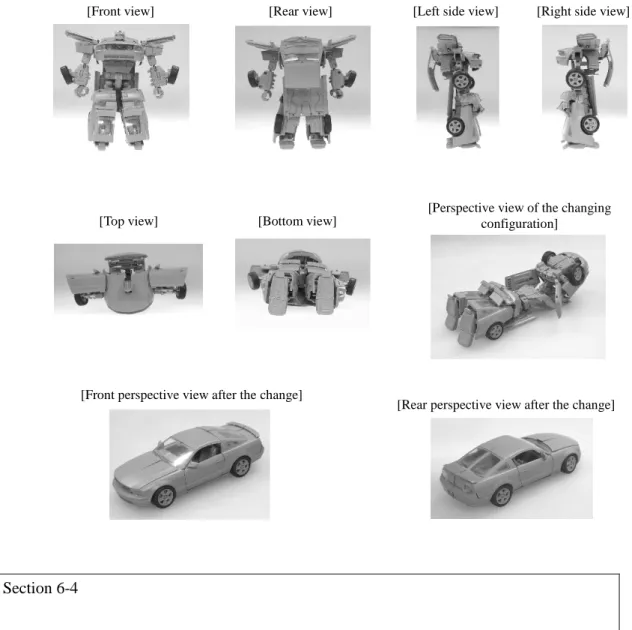
Question 6-4 In the case of a design right for an article which partially changes to perform its functions, does the scope for design protection cover the configurations observed in the course of change? Or, does the scope of design protection cover only the configuration before a change and the configuration after the change?
19
Answer Section 6-4 (Provided by examiner in Design Department of SIPO)
The scope for design protection covers the configurations observed in the course of change.
変化の過程における形態にも権利が及ぶ。
[Front view] [Rear view] [Left side view] [Right side view]
[Top view] [Bottom view]
[Perspective view of the changing configuration]
[Front perspective view after the change]
20
Question 6-5 This question is about the scope of design protection in the case of a set of articles or a certain set of articles. Does the design protection only cover a set of articles or a certain set articles? Or, does the design protection also cover each article that comprises a set?
If simultaneously used multiple articles are coordinated as a whole, the designs of those articles may be regarded as a single design. Such a design may be regarded as a "design for a set of articles." The term "a design for a certain set of articles" is conceptually the same as "a design for a set of articles." The term "a design for a certain set of articles" refers to a design used for any of the prescribed types of set.
Answer Section 6-5 (Provided by examiner in Design Department of SIPO)
The design protection only covers a certain set articles which are the same as products in set (Article 31 of the Patent Law of China). Products in set means that two or more products belonging to the same class, but independent from each other. The design concepts for the products are the same. Each product has its own independent value of use.
As each product has its own independent value of use, the design protection covers each article that comprises a set.
意匠保護は、同一の製品としてセットになっている物品のみに及ぶ(専利法第 31条)。セ
ットの製品とは、種類は同じだが、互いに独立している 2つ以上の製品をいう。意匠の概
念は同じだが、それぞれに独立した使用価値のある製品をいう。
製品ごとに独自の使用価値があるので、意匠保護は、セットを構成する各物品に及ぶ。
Question 6-6 This is a question about the restrictions on the exercise of design rights that are related to each other in conflict of which both right holders and both filing dates are deferent.
Design rights are considered to be related to each other in conflict in the following three cases:
(i) a design right to protect the design of a whole article and a design right to protect the design of a component of the article (the component can be regarded as an independent article). Filing date of the design rigth of a component of the article is earlier than filing date of the design right of a whole article. Both rights are owned by deferent persons;
21
(iii) a design right to protect the design of a set of articles or a certain set of articles and a design right to protect the design of any article that comprises a set. Filing date of the design right of any article that comprises a set is earlier than filing date of the design right of a set of articles or a certain set of articles. Both rights are owned by deferent persons.
For example, in Case (i) above, if the holder of a design right to protect the design of a whole article works the design or exercises the design right, is it sometimes necessary for him/her to obtain a license from the holder of a design right to protect the design of a component? How about the situations in Case (ii) and Case (iii) described above in terms of the restrictions on the exercise of design rights?
Answer Section 6-6 (Provided by examiner in Design Department of SIPO)
In Case (i), it is sometimes necessary. In Case (ii), it is not necessary.
In Case (iii), it is sometimes necessary.
(i)では、必要な場合がある。
(ii)では、必要なし。
(iii)では、必要な場合がある。
Question 6-7 This is a question to the IP Office of any country that protects multiple images as a single design.
If your country does not protect multiple images as a single design, please skip this question and answer Question 7.
In the case of two related design rights, i.e., a design right to protect the designs of multiple images and a design right to protect the design of any of those images, are in conflict. Filing date of the design right of any of those images is earlier than filing date of the designs right of multiple images. Both rights are owned by deferent persons. In this case, are any restrictions imposed on the exercise of those design rights?
22
Question 6-8 This is a question to the IP Office of any country that protects multiple images as a single design and conducts substantive examination. If your country does not protect multiple images as a single design and does not conducts substantive examination, please skip this question and answer Question 7.
In case of a application seeking for a protection of a design of multiple images When filing date of a application seeking for a protection of design of any those images is earlier than filing date of a application seeking for a protection of a design of multiple images, and both applicants are different, what measures do you take when determining whether such a design has novelty and is not easily creatable by any person skilled in the art?
Question 7 Disclosure by drawings included in application documents and publication by gazettes
Question 7-1 Are there any cases where a drawing or photograph included in application documents is edited (e.g., altered in size or ratio) when the design is publicized in a design gazette (including an electronic gazette)? If editing is conducted, please tell us the reasons and standards for editing.
Answer Section 7-1 (Provided by examiner in Design Department of SIPO)
Yes, there are. If the scale of various views is not the same, and it is caused by the scanning entry problem, then the editing is conducted, but only the ratio can be edited, not the content of the design.
ある。さまざまな図の尺度が同じでない場合、それがスキャナーからの取り込みが原因で ある場合は編集を行うが、編集できるのは比率のみであって、意匠の内容を編集すること はできない。
Question 7-2 If a design application is filed by an electronic medium, do you store printed-out hardcopies of the representations of the design as the original documents in addition to the submitted electronic images of those representations? If yes, why?
23
Answer Section 7-2 (Provided by examiner in Design Department of SIPO)
No, we don’t.
保管していない。
Question 7-3 Does the public have access to the documents (including electronic data) prepared in the course of design prosecution starting from the filing of a design application to the registration of the design? If yes, please tell us the inspection fee and conditions (to what extent is inspection permitted? Are there any documents that are not available for inspection?).
Answer Section 7-3 (Provided by examiner in Design Department of SIPO)
Any person may file a request with the Patent Office to consult or photocopy the file of the patent application for granted design. The inspection is for free. Until the announcement of the grant of patent right for design, the requester for consultation or photocopying is limited only to the applicant and agent thereof.
誰でも、登録された意匠の出願ファイルの参照または写しを、特許庁に対して請求できる。
閲覧は無料である。意匠の特許権付与が発表されるまでは、参照または写しの請求者は、
出願人およびその代理人に限定される。
Question 8 Do you receive any opinions from users of the design system such as a request for a revision of the design system in order to change the way of representing a design in a design application under the relevant laws, regulations, and examination guidelines of your country and to remedy the current situation where the way of representing a design differs from one country to another? If yes, please describe those opinions in detail.
Answer Section 8 (Provided by examiner in Design Department of SIPO)
Yes, we do.
We receive opinions such as submitting the drawings of a design application in 3DSMax format, so that the examiner can observe the product in all directions.
出されている。
審査官が製品をあらゆる方向から観察できるようにするため、意匠出願の図面を 3DSMax
24
Question 9 In recent years, has the number of design applications been on the rise or on the decline? What do you think has caused such increase or decrease?
Answer Section 9 (Provided by examiner in Design Department of SIPO)
The number of design applications has been on the rise.
I think the main reason is because of the outline of the national intellectual property strategy’s announcement and the improvement of China’s capacity to create.
意匠出願件数は増加傾向にある。
主な要因としては、国の知的財産戦略の概要が公表されたこと、中国の創作能力が向上し たことなどがあると考えている。
Question 10 If your country has signed the Hague agreement, please answer this question. Did the number of design applications increase or decrease in your country before and after the signing of the Hague agreement?
Answer Section 10
Question 11 If your country has signed the Hague agreement, please skip this question and answer Question 12.
This is a question to the IP Office of any country that is planning to sign the Hague agreement. What are your purposes for signing the Hague agreement? Please describe your purposes in detail.
Answer Section 11 (Provided by examiner in Design Department of SIPO)
Hague agreement is an effective way to protect the design right for Chinese enterprises, especially for those companies who want to compete with other countries.
25
Question 12 Please answer this question if your country has signed the Hague agreement or is planning to do so. In order to sign the Hague agreement, did you have to make any alterations or adjustments to your country's system? Or, is your country planning to alter or adjust your country's system in the future?
Answer Section 12 (Provided by examiner in Design Department of SIPO)
Yes, we are planning to make some alterations or adjustments to our country’s system in the future.
今後、わが国の制度を変更・調整する予定である。
[Request for information]
13 If your country has adopted a multiple design application system, please send us information on how an application and drawings should be prepared in order to file a multiple design application. We would appreciate if you could send us a sample application and a sample drawing that are available for disclosure (those with all the sections filled in with information as a sample). If such application and drawing are not available for disclosure, please send us a blank application form, etc., if possible.
Answer Section 13 (Provided by examiner in Design Department of SIPO)
In china, only two or more similar designs for the same product or two or more designs which are incorporated in products belonging to the same class and sold or used in sets may be filed as one application According to Article 31 of the Patent Law of China. We supply a blank sample application for your reference, the applicant just needs to add the numbers of designs on the portion indicated by red frame compared with the single application.
中国では、同一の製品における2以上の類似意匠、あるいは同一種類でかつセットとして
販売または使用される製品の 2以上の意匠のみを、専利法第 31条に基づき、一件の出願
26
14 Is it possible for you to send us a sample registration certificate? Again, we would appreciate if you could send us such a certificate with all the sections filled in with information as a sample. If such certificate is not available for disclosure, please send us a blank certificate form, if possible.
Answer Section 14 (Provided by examiner in Design Department of SIPO)
Yes, we just send you a blank registration certificate, please see the following page.
1 中国ヒアリング回答(2)
Question 1 Basic principle concerning representations of designs
Question 1-1 In the laws, regulations, examination guidelines, etc., of your country, there are provisions concerning the disclosure of designs. What is the underlying principle behind those provisions that determines the extent of disclosure of designs? In other words, when determining the extent of disclosure of designs, what are the primary goals of your country?
Example answers are listed below. Please give us a detailed answer.
- To facilitate formality examination or substantive examination.
- To facilitate storage of the submitted representations (drawings, photographs, specimens, etc.).
- To reduce the burdens on the users of the design system.
- To facilitate understanding of third parties (those other than design applicants and design holders)
- To facilitate the enforcement of rights.
- To ask for self-responsibility of the applicant who discloses his/her design.
Answer Section 1-1 (Provided by examiner in Design Department of SIPO)
To facilitate understanding of third parties (those other than design applicants and design holders)
第三者(意匠出願人/権利者以外の者)の理解を容易にするため
Question 1-2 In many cases, designers design industrial products by using 3D CAD and CG software. Does your country allow design applicants to use the 3D CG images created in the stage of product design such as those shown below as design representations to be included in design application documents?
[Article which constitutes the Design] Attachable wash-basin [International Design Classification] 23-02
[Description of the Article which constitutes the Design] This design will be used mostly by medical staff to wash their hands in medical facilities, etc.
2 Japan Design Registration No. 1442550
Answer Section 1-2 (Provided by examiner in Design Department of SIPO)
Design applicants can use the 3D CG images.
意匠出願人は、3DのCG画像を使用できる。
→■CGデータを基本6面図(正投影図法)の図面にして出願したもの、との理解で良いで
すか(CGデータ電子媒体は受け付けていないという理解でよいですか)。
■ その場合、3DCGデータそのものの出願を認める予定は検討していますか。
[Perspective view]
[Top view] [Front view]
[Right side view]
[A-A sectional view] [The article in use]
[Left side view] [Bottom view]
3
Answer: Your understanding is correct. But It's hard to answer at this stage when we can use the 3D-CG directly. After all, the 3D-CG date is not widely used in the application document of other countries.
回答:その理解でよいが、現段階で、いつ3D-CGデータそのものを使用できるようになる
かを言うのは難しい。いずれにしても、3D-CGデータは他国の出願書類において、広く使
用されているわけではない。
Question 2 Representations of designs under the system to protect the design of a part of an article (partial design system)
Question 2-1 This is a question to the IP Office of any country that has either a partial design system or a system to protect the design of a part of an article. If you are representing the IP Office of any country that has neither of these systems, please skip this question and answer Question 2-2.
Two specific examples of representations of partial designs are given below. In the case of Example 1, an applicant seeking protection for a partial design used a different color to distinguish the partial design from the rest of the article. In the case of Example 2, an applicant seeking protection for a partial design used a different line (broken line) to distinguish the partial design from the rest of the article. Does your country allow such representations of partial designs? Please tell us whether and why each of the following two methods shown in the following examples is permitted or not?
(Example 1) A case where an applicant seeking protection for a partial design used a different color to distinguish the partial design from the rest of the article
[Article which constitutes the Design] Passenger car [International Design Classification] 12-08
[Description of the Design] The applicant is seeking registration of the partial design of the part other than the pink part shown in the drawings. The bottom view is omitted because this is a heavy article. The shading applied to the entire surface of the 3D configuration presented in each drawing shows the shape of the curved surface.
[Perspective view] [Front view] [Rear view]
4 Japan Design Registration No. 1444223
(Example 2) A case where an applicant seeking protection for a partial design used a different line to distinguish the partial design from the rest of the article
[Article which constitutes the Design] Packaging container
[International Design Classification] 09-01、09-02、09-03、09-04、09-05、28-01
[Description of the Design] The part drawn by a solid line shows the part for which the applicant is seeking registration as a partial design.
The rear view is symmetrical to the front view The bottom view is the same as the top view.
5
[Front view] [Top view]
[Left side view] [Right side view]
[Enlarged perspective view of the cap 1]
[Enlarged perspective view of the cap 2]
[Enlarged front view of the cap] [Enlarged top view of the cap]
[Enlarged left side view of the cap]
[Enlarged right side view of the cap]
6 Japan Design Registration No. 1449069
Question 2-2 This is a question to the IP Office of any country that has neither a partial design system nor a system to protect the design of a part of an article. If you are representing the IP Office of any country that has either of these systems, please skip this question and answer Question 3.
Do the users of the design system of your country request protection for the partial designs of articles? For example, is there a need for the establishment of a partial design system, which is an effective countermeasure against infringers of partial designs who copy only a unique and innovative part of an article without copying the design of the article as a whole?
Answer Section 2-2 (Provided by examiner in Design Department of SIPO)
Yes,We do have a need for the establishment of a partial design system. 部分意匠制度のニーズはある。
→■日本で部分意匠であった出願を優先権主張して中国に出願するときに部分意匠から全 体意匠に直すことを許容していると聞いていますが間違いないですか。これについて 審査指南やガイドラインに明記されていますか。
Answer:
Yes, it is true that we can submit a whole design claiming the priority of a partial design according to the practice, we only need to amend the dotted lines as the solid lines, but it is not explicitly specified in the Guidelines for Patent Examination.
回答:
その通りである。部分意匠の優先権を主張する全体意匠を提出することができ、点線を修 正して実線にするだけでよいという運用が行われている。ただし、特許審査ガイドライン には明記されていない。
Question 3 The policy of conducting to find designs
Please answer this question regardless of whether your country has adopted a system that conducts only formality examination before registration, a system that conducts both formality examination and substantive examination before registration, or a system that conducts formality examination on all applications and conducts substantive examination only on certain applications before registration.
7
Question 3-1 In the course of formality examination on the design claimed in an application, to what extent do you conduct to find the design? Example answers are listed below. Please give us a detailed answer.
- We examine whether an application satisfies the prescribed formality requirements such as the number, sizes, etc., of the submitted drawings or photographs but do not examine the design in further detail.
- In addition to whether a design satisfies the formality requirements, we conduct to find out whether the design is disclosed in accordance with the relevant regulations by taking into consideration the article that embodies the design and checking the drawings, photographs, etc., submitted by the applicant.
- If we conduct to find design and determine that the design fails to satisfy the substantive requirements for design registration (e.g., the case where the design clearly lacks novelty), we conduct substantive examination as well
Answer Section 3-1 (Provided by examiner in Design Department of SIPO)
In addition to whether a design satisfies the formality requirements, we conduct to find out whether the design is disclosed in accordance with the relevant regulations by taking into consideration the article that embodies the design and checking the drawings, photographs, etc., submitted by the applicant.
形式的な要件に加え、意匠にかかる物品を考慮し、提出された図面あるいは写真等を精査 して意匠を認定し、規定通りに意匠が開示されているかを判断する。
Question 3-2 Who conducts the formality examination mentioned in Question 3-1? Is it conducted by a formality examiner, Office staff member, or any other staff member (including a substantive examiner)? Please specify.
Answer Section 3-2 (Provided by examiner in Design Department of SIPO)
Only the formality examiner.
方式審査官のみ
→■具体的には、外観設計審査部の審査官ですか。現在の人員数は何人ぐらいですか。
Answer:About 210 examiners.
8
Question 3-3 Do you have a system to invalidate a registered design right on the grounds that the design is unclear for such reasons as the design right having an unidentifiable scope? Example answers are listed below. Please give us a detailed answer.
- System to file a request with the IP Office for commencement of examination - System to file a request with the IP Office for an invalidation trial
- System to file a lawsuit with a court
Answer Section 3-3 (Provided by examiner in Design Department of SIPO)
We gave a system to file a request with the IP Office for an invalidation trial.
知的財産担当官庁に対する無効審判の請求制度がある。
→■具体的には復審委員会における評価書のことですか。
Answer:
In practice, regarding a registered design, the public can file a request for invalidation with the Re-examination Board of SIPO (“復審委員会”), after examination, the Re-examination
Board will issue a decision on whether the design right should be invalidated. During the examination, the Board will transfer the invalidation request to the patentee and give a chance for the patentee to make argument, and before making a decision, the Board may hold a Hearing for the parties to make further statements.
As for “評価書”, “the evaluation report of patent”, it is accomplished by the department of
design examination ” upon the request from the patentee or the interested party(ies).
回答:
登録意匠に関して、復審委員会に無効化を請求することができ、復審委員会は審査の後、 意匠権を無効にすべきか否かの決定を行う。審査中、委員会は無効化請求を特許権者へ転 送し、意見書を提出する機会を与えるとともに、決定の前に、当事者がさらなる陳述を行 うための口頭審理を実施することもある。
評価書については、特許権者または利害関係者から請求があった場合に、意匠審査部門が 作成する。
9
Answer Section 3-4 (Provided by examiner in Design Department of SIPO)
Yes, there are.
If the content of the drawings or photographs of a design patent has defects that cause the uncertainty of the protection target of design, it may be excluded from the patent protection under Article27.2 of the Patent Law of China.
ある。意匠特許の図面または写真の内容に瑕疵があり、それによって意匠の保護対象が不
明確な場合は、専利法第27.2条に基づき、特許保護が受けられない可能性がある。
→■権利化されたものの、復審若しくは裁判で意匠が不明確として権利無効となったケー
スはありますか。あれば例示をください(ヘアドライヤーの事例(2007高行終審第169
号)以外にあればご報告下さい)。
Answer:
As that indicated in the Invalidation decision No. 5097(please see the attached), because the bottom view and the top view completely can not coincide completely and the front view and the right view can not coincide completely, so cause the uncertainty of the protection target of design we can not confirm the specific design based on all the views,that is to say, the
uncertainty of the protection target of design.
回答:
無効審決第5097号(添付を参照)では、底面図と上面図が完全に一致せず、正面図と右側
面図が完全に一致しないため、意匠の保護対象が不明確とされた。すべての図に基づいて、
特定の意匠を確認できない、つまり、意匠の保護対象が不明確。
Question 4 Principle concerning amendments
Question 4-1 Is it permitted to amend a design application? If yes, what restrictions are imposed on an amendment in terms of time schedule and content? Please tell us any restrictions imposed on an amendment in practice other than those specified in the laws, regulations, examination guidelines, etc., that we should know about. Furthermore, is it permitted to make a voluntary amendment?
Answer Section 4-1 (Provided by Linda LIU & Partners)
Yes, it is permitted to amend a design application. Amendments can be made according to the examiner’s request or initiatively by the applicant.
10
After receiving the official notification from SIPO, the applicant can make amendments to the defects that indicated by the examiner within the designated time limit, usually within 2 months from receiving the notification.(Rule 44 of the Implementing Regulations of the Patent Law of China)
SIPOから通知を受けた場合、出願人は、指定された期限(通常は2カ月)内に、審査官が
指摘した瑕疵を補正することができる(専利法実施細則第44条)。
Voluntary amendments to the drawings/ photographs or explanation of the design can be made within two months from the filing date. (Rule51.1 of the Implementing Regulations of the Patent Law of China)
図面/写真または意匠の説明に対する自発的な補正は、出願日から 2 カ月以内に行うこと
ができる(専利法実施細則第51.1条)。
All the amendments may not go beyond the scope of the disclosure as shown in the initial drawings or photographs. (Article 33 of the Patent Law of China)
すべての補正は、最初の図面や写真による開示の範囲を超えてはならない(専利法第33条)。
→■開示の範囲を超えているか否かを判断するのは誰ですか(Q4-3回答によると、おそら
く方式審査官と思われますが正しいでしょうか)
■ 2ヶ月を超えて補正したらどうなりますか。手続却下でしょうか。
Answer:
1. Yes, it is determined by the preliminary examiner.
2. If an official notification of correction is issued, the applicant should make corrections or statements in this regard within the designated time limit (usually 2 months after receiving the notification). In case that the applicant fails to meet the time limit, the application will be deemed as being withdrawn.
If the applicant submits the Voluntary amendments beyond two months from the filling date, the examiner can refuse to accept it, but it would not be absolute. If this amendment has made to the problem of non-corresponding projection relationship, usually the examiner can accept it.
回答:
1. その通りであり、判断を行うのは、方式審査官(preliminary examiner)である。
2. 正式な修正の通知が出されたら、出願人は、これに関する修正書または陳述書を、指定さ
れた期間内(通常は、通知を受け取ってから2カ月後)に提出する必要がある。この期限に
間に合わなければ、出願は取り下げられたものと見なされる。
出願人が、出願日から2カ月を過ぎてから自発的な補正を提出した場合、審査官は受理を
11
Question 4-2 What may be submitted to make an amendment? Please tell us what may be submitted in practice other than those specified in the laws, regulations, examination guidelines, etc.
Answer Section 4-2 (Provided by examiner in Design Department of SIPO)
To make an amendment, the applicant shall submit rectification with the signature or seal on it, and the corresponding replacement sheet of the amended documents.
補正を行うには、出願人は、署名または捺印した修正(rectification)、および補正する書類
の差替えを提出しなければならない。
→■これについてのガイドラインはありますか。あればお教えください。
Answer:
According to the provisions of 3.4 Chapter 3, Part I of the Guidelines for Patent Examination, when making corrections / rectifications to the application, the applicant should file a Request of Correction form and corresponding replacement sheet.
And according to the provisions of 8 Chapter 1, Part V of the Guidelines for Patent Examination, the documents submitted to the Patent Office shall be signed or sealed.
Moreover, Rule 52 of the Implementing Regulations of the Chinese Patent Law prescribes that “where an amendment to the drawings or photographs of an application for a patent for design is made, a replacement sheet shall be submitted as prescribed.”
回答:
特許審査ガイドラインの第I部第3章3.4の規定によれば、出願の修正/訂正を行う場合、
出願人は修正申請書と、対応する差替え頁を提出する必要がある。
また第V部第1章8の規定によれば、特許庁へ提出する書類には、署名または捺印が必要
である。
さらに、専利法実施細則第52条は、「意匠特許出願の図面又は写真の補正は、規定に基づ
いて差し替え頁を提出しなければならない」と規定している。